Showing posts with label non-fiction. Show all posts

Wednesday, January 9, 2019

Automatic Chapter Numbers in Microsoft Word (Mac 2016)

I finished a draft of Winter Yield last weekend, and am now in the 'cleaning up phase' of addressing comments I left for myself. Since I find this very tedious, I rewarded myself for two hours of work this morning by finally learning how to automate chapter numbers in Microsoft Word.

Three parts to the lesson:
  • Using headings for navigation and formatting
  • Adding automatic chapter count in headings
  • (bonus) Adding page numbers in chapter headings

Using headings for navigation and formatting

This was the step that stopped me the first time I tried this. But thanks to a lesson from my esteemed critique partner C.R. Hodges, I am now using the navigation pane to not only see the master layout but also to immediately jump to any chapter start that I want.

In the Home menu, the heading styles are listed along the top right. Highlight the text you want to use (here, Chapter Something) and click Heading 2.

Note that I use Heading 1 for my Sections/Acts, and so chapters are Heading 2. 
Clicking on the far right 'Styles Pane' allows you to modify how this heading appears, but I just stuck with the default,

Adding automatic chapter count in headings

Now that we have the section and chapters, I can modify them to include automatic counts, and even the word Chapter and Section.

In the very top menu (File Edit View etc..., not the Home, Insert, Design, etc we just used), select Format: Bullets and Numbering


In the box that pops up, select Outline Numbered (blue box). This shows eight different pages. Other than the empty 'None', all but one have outline-type indents. So select the only one that looks like pages, in my view it is the bottom right corner option and there are even 'Chapter' words in it. 

Once it is highlighted/selected, click 'Customize'.


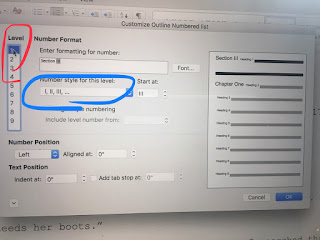
 Level on the left (red circle) seems to relate to the hierarchy of the headings, so I select Level 1 for my sections. I choose capitalized Roman numerals from the drop-down menu circled in blue. In the text box above it "Enter formating for number" I add Section before the automatic gray field. 


Similarly for chapters, which are Level 2. The one piece I couldn't get to work was continuing the chapter numbering in each new section. On the previous page (Outline Numbered) there is a box in the lower left corner to select 'Continue Numbering' but this doesn't help. The only way I could get it to work was to hard-code the chapter each section should start with in the green circle. This wasn't a big deal since I only have four sections, but if anyone knows how to make this work, please comment on this post!


 Then I had to go through and take out all my hard-coded Chapter N's... but it was worth the time investment because I won't have to hard-code them again!

Adding page numbers in chapter headings.

One last piece was to add automatic page numbers in the chapter headings. In order to make sure I have interesting things happening in my novel, I'm following the enviable Susan Spann's model of five-page chapters. So while I'm writing, I want to know what page each chapter starts on. I have been putting this in the headings so it shows up in the navigation panel, but again the hard-coding requires a lot of updating when I change things. In reading up about numbering, I was introduced to the concept of Fields, and I stumbled across this way to add automated numbers anywhere in the text.

In the Insert menu, a little white box on the far right (red circle below) inserts a frame.
Select Numbering (blue circle) and Page (green), and now it will update that frame with the actual page number.


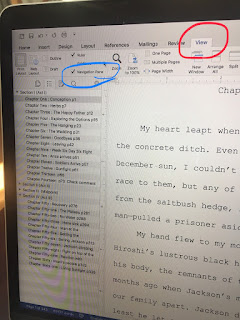
Completed view: To see the navigtion frame, click View (red) and select Navigation (Blue). Now the left side of the screen has a collapsable list of sections and chapters, with the accurate numbers and the page numbers so I can see them at a glance. (The pane can be resized by clicking and dragging the border; the headings missing page numbers are just too long to be shown). Clicking any of the chapter headings in the navigation pane takes me to that text instantly. Yay!


Thursday, May 5, 2016

Review: The Way of the River by BK Loren

The subtitle of the book is "Adventures and Meditations of a Woman Martial Artist" and one review that I read before checking this out said she didn't think it was applicable to the book that the author was female. While it's true that the insights BK Loren offers should be of interest to people of any gender, being female is of fundamental importance to the experiences in and uses of martial arts that she describes.

As a female martial artist of almost twenty years, I was fascinated to read of the ease of which the author excelled in the styles she practiced. One thing my experience in martial arts has taught me is the importance of size and strength. I've realized how much, on average, women are at a disadvantage in a physical confrontation. Although I am confident that practicing a martial art will mitigate those disadvantages, the net result will depend on the situation and other people involved. So far, this remains untested for me. I attribute this to a combination of the privilege of my socio-economic class, simple dumb luck and possibly avoiding acting like a victim, but I'm not stupid enough to think it might not, someday, be tested. So it was intriguing to learn that the author attributes so much of her success both in and outside of the kwoon to the practice of internal martial arts.

When I was competing in karate tournaments ten years ago, I started practicing yoga to increase the stillness of my mind and balance in my body. Back then, this was a separate discipline from my martial art training but I am lucky enough to be part of a martial arts school that does not stand still. Our Fukukancho, Mike Ninomiya, is bringing yoga and qigong practice into the dojo since he believes those practices will not only help us age gracefully but are also key to successful fighting. This book repeatedly validated that belief: almost all the physical confrontations the author describes were resolved without force, using instead the acute observational and decision-making abilities that she has learned and practiced in her martial arts training.

It is for this reason I believe this book would be of interest to a wider audience than just female martial artists (although I recognize my inability to make that judgement from the 'inside'). So much of self-defense is about what comes before things get physical. So much of a healthy life comes from granting attention to the silence within. So much of living on Earth involves recognizing that humanity is simply a part of the natural world.  BK Loren expresses these sentiments and more with this collection of sometimes beautiful and sometimes disturbing anecdotes, so that reading this collection feels like dipping into a river of refreshing and challenging insights. 

Monday, March 28, 2016

Scarcity and Incentives

When one of our children has earned enough glass "gems" to fill up her reward jar, she can choose a 'special thing.' There are limited choices: go see a movie in the theater, buy a book at the book store, go to the Butterfly Pavilion or get to have a meal at Noodles and Company. Over the four years we've been using this system, our three kids have all used the first three options.  However, no one has ever chosen the fourth.

Why not? We rarely go to movies, the kids rarely get to purchase anything new and we reserve the Butterfly Pavilion exclusively for these special trips. Going to Noodles and Co for a meal, however, is not a rare event.  Why would the kids waste a once-every-few-months 'special thing' on something they're likely to get every month anyway?

There is a larger truth, here, too. If you use incentives to affect your children's behavior, it is good to start from a base of scarcity. If they get candy every night after dinner, are they going to be motivated by an extra piece? If they get to go to a movie every month, will they be motivated by going again? If they get thirty minutes of screen time every day, is the promise of an 'extra' show going to make a difference? If Grandpa brings a toy whenever he comes to visit and Mom brings one whenever she returns from a business trip, is the promise of a new toy going to motivate the kid? If they get a dollar a day allowance, is a new toy going to offer any incentive over what they can purchase on their own?

Here are a few guidelines we've used concerning incentives:

  1. Choose something they want. Sometimes it can be naturally connected to the behavior but it doesn't have to be. You are introducing an external motivation and once you tell them it's connected, it is.
  2. Small, repeated incentives are more likely to be effective than one grand item. This seems to have two causes: A) repeating a behavior makes it a habit and B) the parent is more willing to withhold a small reward that the child has a chance to earn again. 
  3. Withholding the incentive when the behavior does not meet expectations is as much as part of it as rewarding when it does. If they can get the reward either way, why would they bother to behave?
  4. Scarcity breeds opportunity. It is worth the difficulty of restraining them from excessive sweets, toys, movies or whatever in order to use those (which you wish to use) as incentives when you've decided a behavior is truly unacceptable.
The gem jars are a successful system for us (kids now 4 and 8 years old). One of the best parts is that I'm willing to make them take a gem out whenever a rule, no matter how small, is broken. We give three gems a night (one for going to bed without a fuss, one for not waking us up during the night and another for staying in bed until they're supposed to get up) so, if a kid has a nightmare or a leg ache, they only lose one of three. Still getting two gems doesn't feel like a punishment yet the philosophy is reinforced: they only get the gems they earned. 

One other incentive we've used was a reward chart for our 4 year old when she was awake for hours each night. I printed out an excel spreadsheet with 4 rows x 7 columns; at the end of each row was a picture of a piece of the Halloween costume she wanted: Elsa wig, Elsa shoes, Elsa dress and Elsa make-up.  It was about 5 weeks until Halloween when we started, so we could afford to *not* give her some stickers at the beginning (see point 3!). She ended up earning all the rewards and, after a month of practice, gained the capability of turning on her light and reading if she woke in the middle of the night. Half-way through, her sisters decided it wasn't fair that she was going to get a purchased Halloween costume, since we usually make them, and asked for reward charts of their own. In this case, buying a few items was well worth the resulting behavior. But again, if the were accustomed to getting costumes that they asked for, the incentive wouldn't have worked so well.  Scarcity breed opportunity!


Thursday, March 3, 2016

Review: Search and Rescue in Colorado's Sangre de Cristos


Part thriller, part how-to manual, part philosophical treatise, this collection of true stories provides a window into the realities of Search and Rescue.

Full of useful tips like how not to go off the route on descent, how to keep warm in frigidly cold environments and how to slow the bleeding from multiple head wounds, the stories leave the reader with respect for the risks inherent in the mountain environment and an understanding of just how difficult and dangerous a rescue can be.

The author shows the care and respect that the men and women of SAR have for each other, as well as for the victims who they recognize as not much different from themselves.


Goodreads
Amazon

Sunday, August 30, 2009

Potty training

I started this blog with the idea of posting fiction & poetry but our experience this month potty training the girls inspired an article about it. Actually two: here's the long version, which I'm considering marketing to some parenting magazine or other.

(It will be obvious to you that I changed the girls' names)

Potty training in one day??!!

With 22-month old twins, we go through a lot of diapers: seventy a week from the cloth-diaper service plus about twenty disposable for nighttime and day trips. Soon after they were born, I read in a parenting book that 18 months was the earliest some children are ready to be toilet trained and this stuck in my head as a goal. Of course, when they reached that age, we didn’t seem to be anywhere near it. However, an extended visit from my sister’s family a few months ago—with her 2 ½ year old, potty-trained daughter—inspired an enthusiasm for the potty that I wanted to capitalize on. We would sit them on the potty seat on our big toilet but they rarely did anything. It seemed to me that they were prime candidates for the ‘One-day’ potty training methods: they were interested but needed practice to understand what their bodies were supposed to do. I wanted to try it before they got too resistant toward doing anything we suggest, a behavior that seems to be creeping in more and more each day.

So we checked out a few books from the library: “Toilet training in less than a day” by Nathin Azrin & Richard Foxx for my husband and I and a “Potty Book for Girls” for the girls. We waited until our summer travels were over and a weekend was free. And then we tried it—unsure if we would magically be free from diapers or ruin everything trying too early.

Saturday morning: We clear the toys from the living room, roll up the rug and stock a shelf with treats: cheerios, gold fish, chocolate bunnies, yellow pear tomatoes, boxes of apple juice, cans of orange soda, sippy cups of herbal tea. Two little potties sit against one wall; we bring out our Camelbacks and the doll-that-pees that the neighbor lent to us.


The girls change into their big-girl panties—of course Rosie picks purple. The doll sits on the potty and doesn’t pee… they give her a bottle and then she does pee! We jump around and celebrate and offer her some juice as a reward but since she doesn’t drink it the girls get it. They rarely get juice and even more rarely from a box so they suck it right down. Repeat a few times before the doll has an accident and has to clean up the mess and practice going potty. The girls like the doll and playing with her. They find the Camelbacks and absorb more liquid. Herbal tea? Of course! Salty snacks? Of course! Are their panties dry? Yep—more treats. Now it’s time for Gemma & Rosie to sit on the potty, but nothing happens. We don’t make them stay the recommended ten minutes: three seems like an eternity.

We try to keep them in constant motion—feeding the doll, watching her pee, always checking that their panties are dry and getting treats. I’m not sure why this is part of the method but it seems like it should be hectic with activity.
In an instant, Gemma is standing in a puddle. Uh oh. Wet panties, we don’t like wet panties. Clean up the mess, practice running to the potty, pulling down your panties, sitting down, standing up, pulling up your panties. We’re supposed to do this ten times but on about the third trial, she pees on the potty. Yay!! Potty party!!! We jump around and cheer and abort the practice rounds. Then Rosie pees on her potty. Yay Rosie! Such a big girl!! Let’s call Grandma and Grandpa! Here’s some soda and a potato chip for being such a big girl! A little parade of chubby babies carrying their pots to the toilet to flush away.


And then all the liquid starts coming out. I think they peed every three minutes for the next three hours. Some of it went in the potty. A lot of it went on the floor. Some on the couch and some on Daddy’s leg. Rosie was having such a hard time getting the panties pulled up over her copious bottom that she started refusing to put them back and just ran around naked. Part of the method is that the child is supposed to do everything for themselves which seems impossible the first day of the training. Getting the panties up and down is very difficult and dumping the little potty into the toilet seemed impossibly dangerous. Not that the floor hadn’t already been hit with a lot of urine!

After Gemma got ‘bit’ by the lid of the potty falling down on the peak of her bottom, she had about an hour of crying and refusing to sit on the potty. But at lunch time (a picnic of nachos on the living room floor) she jumped up and said “have to pee!” and made it to the potty. Sometime during the morning, Rosie did it too. Then they both had accidents.

It was a relief to put on diapers for their nap. During the down time, Daddy slept while I went running to burn off the stress and figure out what to do for the rest of the afternoon. Finally free of the frantic, urine-spouting situation, I realized that the girls had both achieved the goal of the method: to decide for themselves to sit on the potty and produce urine on it. But was this “trained?” It certainly didn’t feel like it to me. We decided to lay off the liquids for the afternoon, bring down the pace and let the girls play naked in the kiddie pool, with the potty chair nearby for anyone who wanted to use it.

And Rosie did. She woke up ready to conquer the potty-training world and, despite two more accidents in the afternoon, used the potty a lot. On Sunday she had three episodes of peeing a little bit, stopping it and making it to the potty to let the rest out. By Monday, she was really doing the entire process by herself, including a poop in the morning that I only knew about when she asked me to wipe her. She would often sit on the potty going but her only accident of the day was while riding in the stroller.

Gemma, on the other hand, didn’t pee in the potty all Saturday afternoon nor on Sunday. She had lots of accidents, including pooping in her pants and not even telling us about it, but wouldn’t produce anything in the potty itself. On Monday, with Daddy back to work, I sent Rosie to the playground with Grandpa while Gemma and I re-created the original training. Except this time I slowed down the pace and also made her sit on the potty for three minutes on, three minutes off, in hopes of getting more pee in the potty. And she did pee in the potty- about 8 times by the end of the day. Concentrating on just one child made it easier for me to see when she had to go (she really does cross her legs) and more attentive to making her go often enough to avoid accidents. But she still always answered ‘no’ when I asked if she need to pee so the only reason she wasn’t wetting her pants was that *I* was watching out for her. This is when they say the parent is potty-trained, not the child.

But by Wednesday, she was answer ‘yes’ when I asked if she had to go… and she finally pooped in the potty. Maybe not coincidentally, Rosie had two poop accidents on Thursday. On Friday I offered lollipops for any pooping in the potty and they each earned one. By Saturday, we weren’t wearing plastic pants in the car anymore and on Sunday we went grocery shopping, to a picnic and then out for dinner—the girls both used the big toilets at each location (sometimes multiple times!) and no one had an accident. They aren’t spontaneously telling us that they need to go to the potty but when we ask, we trust them whether they say they need to go or not.

Of course, we expect accidents will continue for months to come. And I’ve still got my fingers crossed that one of them doesn’t get scared off of it somehow. But we’re cancelling the diaper service tomorrow, and I’ve started to tell people they’re potty trained. And I’ve started to recommend the method, with some caveats.
The major thing to be aware of is just how exhausting the method is. Maybe it is only one day of intensive training but it really was six or seven days before I felt a little more relaxed. When my husband went back to work on Monday I felt the same sort of panic that I did when the girls were newborns and I wasn’t sure how we’d survive the day on our own. Definitely clear your schedule for two days (although sympathetic house guests after the initial phase can provide a welcome distraction). Expect to stay close to the house and be prepared to take a potty outside if you go. I’m still carrying the potty seat and a square baking pan for roadside urgency. If you can get extra help for the following week—preferably babysitting other siblings or sitting in the house while you get some exercise or making dinner while you watch for signs of elimination—your sanity might fare better. And I would strongly recommend separating multiples for the initial training- they are learning so much that first day that they need to concentrate on themselves.

One thing that I hadn’t expected was how much I would bond with the girls during the experience. When Gemma finally peed in her potty again on Monday, I was sitting on the floor in front of her and we pressed our noses together and giggled; I thought I was going to cry with joy that she had actually done it. And still, if I catch her eye when I hear the tinkle, she wrinkles her nose up and laughs, saying “I pee Momma!” I’m so proud of them for achieving what is truly their first accomplishment; watching Rosie pull her pants down with ease and carry the pot carefully to dump, it’s just hard to believe she only learned it a week ago. And it’s hard to believe that these little people, still miniatures, are this one huge step closer to growing up.